10 Must-Do Exercises for Senior Golfers: Improve Strength, Flexibility, and Boost Your Game

As we age, staying mobile and strong becomes even more important—especially for golfers who want to maintain (or even improve) distance and consistency on the course. Below, you’ll find ten exercises that focus on building mobility, strength, and stability in the key areas that affect your swing. Incorporate these into your regular routine to help reduce injury risk and boost your overall performance.
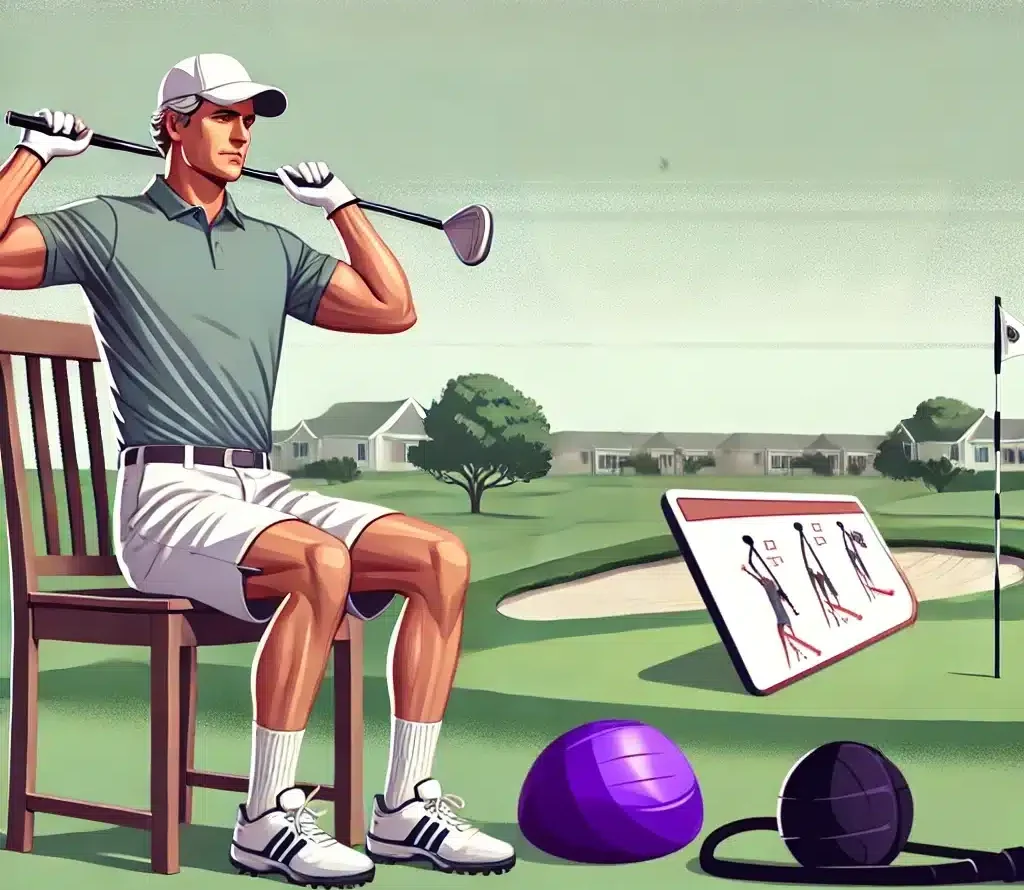
1. Seated Thoracic Rotation and Side Bend
Focus: Mobility in the upper back (thoracic spine) and rib cage.
- Begin seated on a box, chair, or bench with feet about shoulder-width apart.
- Place both hands behind your head, elbows pointing out to the sides.
- Rotate your upper body to the left. Let your head turn with your shoulders.
- Once you’ve rotated as far as you can, side bend toward your left. Take a deep breath in and exhale to relax into the stretch.
- Return to the upright position (still rotated), check if you can rotate a bit further, then bend to the side again. You’ll notice increased range of motion with each repetition.
- Repeat on the opposite side.
Tip: Keep your lower body stable and focus on moving through the upper back. This exercise loosens the upper torso to help with more fluid rotation in your swing.
2. Anti-Rotation Press (Paloff Press Variation)
Focus: Core stability, especially in resisting rotational forces.
- Secure a resistance band or cable to a sturdy anchor at chest height.
- Stand with feet about shoulder-width apart (an alignment stick or line on the ground can help you center your stance).
- Grasp the handle with both hands and hold it at the center of your chest.
- Press the handle straight out from your chest while keeping your core engaged—resist the band’s pull trying to rotate you toward the anchor.
- Slowly bring the handle back to your chest, maintaining control and alignment.
- Perform multiple reps, then switch sides so each side of your body resists the pull.
Tip: Keep a slight bend in your knees and maintain a stable base. Focus on tightening your abdominal muscles to prevent any twist.
3. Dumbbell Scapular Retractions
Focus: Strengthening the small muscles around the shoulder blades to improve posture and shoulder stability.
- Use light dumbbells (e.g., 2 kg or 5 lbs)—these are small muscles that can fatigue quickly.
- Stand in your golf stance: feet shoulder-width, slight bend in knees, hinge at the hips with a flat back.
- Let the dumbbells hang in front of you, palms facing each other.
- Rotate your thumbs outward to open the shoulders, then pull your shoulder blades back and together (retraction).
- Pause at the top, feeling the squeeze between your shoulder blades, then lower the weights slowly.
Tip: Avoid shrugging your shoulders; the movement should come from pulling the shoulder blades together, not lifting them up.
4. Dumbbell Goblet Squats (Using a Box or Chair)
Focus: Building leg strength, improving balance, and reinforcing proper squat form.
- Stand with feet slightly wider than shoulder-width, toes turned out a bit.
- Hold a dumbbell under your chin, cradling it with both hands (like a “goblet”).
- Slowly lower yourself onto the box/chair by bending your knees and hinging at the hips.
- Keep your back straight and avoid letting your knees collapse inward.
- Lightly touch the box, then drive through your feet to stand back up.
Tip: Engage your core and keep your weight in your heels. Using a box helps maintain consistent depth and provides support.
5. Single-Leg Balance Taps
Focus: Improving balance, foot stability, and lower-body strength.
- Stand on one leg (left leg first), planting your big toe, little toe, and heel firmly on the ground.
- Slightly bend that knee and hinge forward at the hips.
- With the free leg (right leg), tap the ground straight in front of you, then return to center. Tap to the side, return, and tap behind you, return.
- Keep your body weight over the standing leg and maintain a stable posture.
- Switch legs and repeat.
Tip: If balance is a challenge, start with just front taps and gradually add side and rear taps as you gain stability.
6. Pelvic Tilt (Floor-Based)
Focus: Core activation and lower-back mobility.
- Lie flat on your back with knees bent, feet on the floor. Place a small gap between your lower back and the ground (neutral spine).
- Gently tuck your hips so that your lower back presses into the floor. Hold for 2–3 seconds.
- Relax and let your lower back arch up slightly (returning to neutral).
- Repeat for several reps, focusing on initiating the movement from your pelvis.
Tip: Avoid a big, forceful movement—small, controlled tilts are most effective for strengthening and stabilizing the lower back.
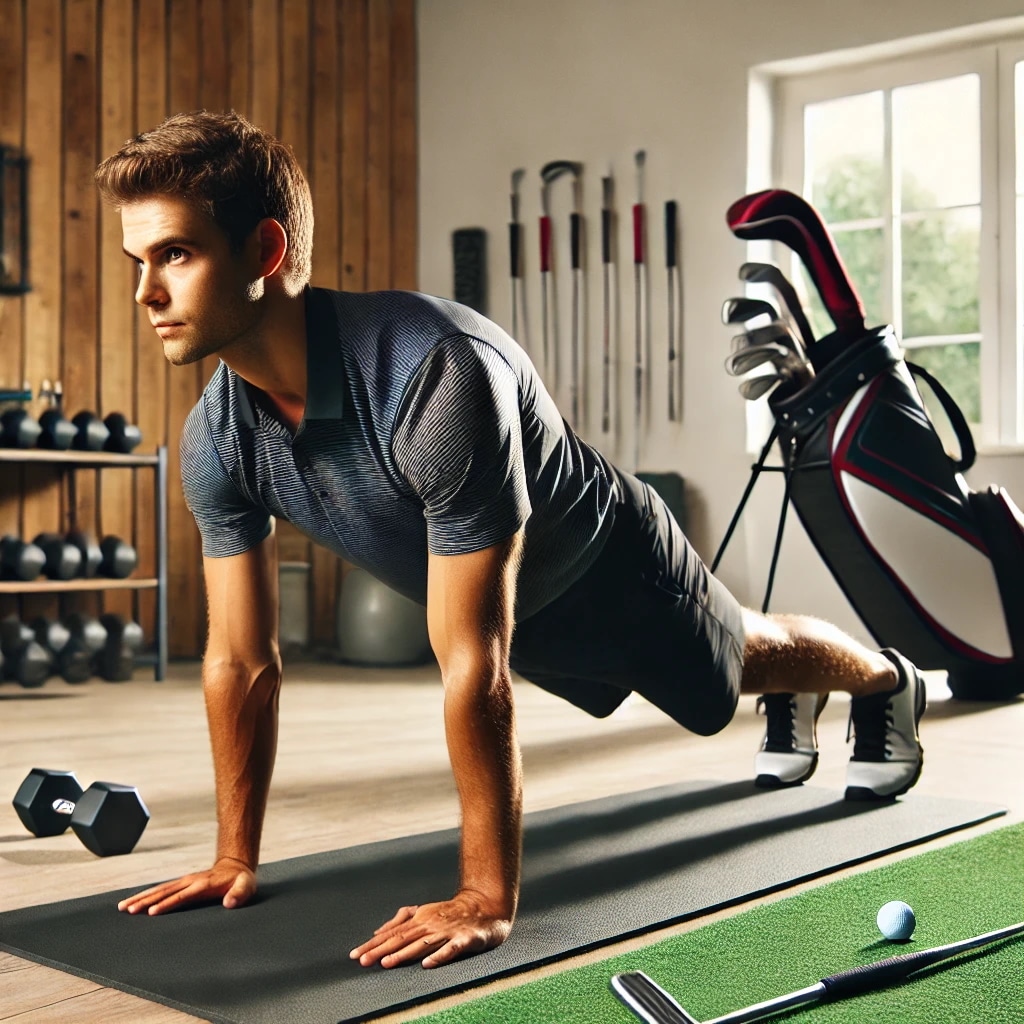
7. Elevated Push-Up (Bench or Box)
Focus: Upper-body strength and core stability with less strain than a standard floor push-up.
- Place your hands on a bench or box, slightly wider than shoulder-width.
- Extend your legs behind you, forming a straight line from shoulders to heels.
- Lower your chest toward the bench, maintaining that straight line (no sagging hips or raised butt).
- Press back up to the start position.
- Adjust the height of the bench or box as needed to modify difficulty.
Tip: Keep your core engaged the entire time. If you find it too easy, lower the angle (use a smaller box or do a standard push-up on the floor).
8. Hip Rotation Drill (Alignment Stick)
Focus: Increasing hip mobility for a smoother golf swing turn.
- Position an alignment stick or a golf club across the top of your waistband, holding it against both hip bones.
- Step one foot forward (right foot if you’re focusing on the right hip). The other foot stays on its toes for balance.
- Rotate your hips into the forward leg (right hip in this case), trying not to let the stick slide around.
- Let your upper body turn with the hips, but keep most of the rotation coming from the pelvis itself.
- Return to neutral and repeat, building up rotation range over time. Then switch legs.
Tip: Even small degrees of rotation help. The goal is quality of movement, not maximum twisting force.
9. Cable Wood Chops (Pulley Wood Chops)
Focus: Core strength, rotational power, and control.
- Attach a cable at about chest height and stand with feet just outside shoulder-width.
- If the cable is on your right side, grip the handle with your right hand first and left hand over the top.
- Extend your arms out from your chest. In a controlled motion, pull the handle diagonally down across your body.
- Keep your right arm straight as you move; let your torso rotate but keep your core braced.
- Slowly return to the starting position. Repeat for several reps, then switch sides.
Tip: Focus on a smooth, controlled movement rather than a fast yank. This builds stability and strength for your golf swing’s rotational demands.
10. Loaded Follow-Through (Medicine Ball)
Focus: Power generation and proper weight transfer in the golf swing.
- Hold a medicine ball close to your chest while standing in your normal golf stance.
- Load your trail side (right side for right-handed golfers) by shifting your weight into that foot.
- Drive off the trail foot, rotating your hips and torso to face the target as you bring the ball through.
- Finish with your chest facing forward and your trail heel lifted as if completing a swing.
- Return to the start and repeat. Focus on a fluid shift of weight from trail side to lead side.
Tip: Keep the movement athletic and rhythmic. Imagine you’re completing a golf swing—this helps transfer the pattern directly to your game.
Wrapping Up
Each of these exercises targets a different aspect of golf fitness—from upper-body mobility to lower-body strength and core stability. Consistently practicing these movements will not only help you increase your swing speed and distance but also reduce the risk of common golf-related injuries. Remember to start with light weights or minimal resistance, focus on proper form, and gradually progress as you build strength and confidence.
Give these ten exercises a try and watch your flexibility, balance, and on-course performance reach new heights!